The short version
A realistic beginner roadmap for learning paragliding in India, from school selection and ground handling to supervised solos and independent progression.
Begin with structured instruction
Learning paragliding is not the same as taking a tandem joyride. A student must understand equipment, weather, sites, decision-making, launch, control and landing before progressing toward independent flight. The safest starting point is a recognised school with qualified instructors, a documented syllabus and suitable training sites. Online videos can support revision but cannot supervise a wing, assess conditions or correct a developing mistake.
The Paragliding Association of India publishes a national rating framework and school guidance, while APPI provides an international education system used by affiliated professionals. Ask the school which system it teaches, who validates skills and what certificate or rating the student can realistically earn. Avoid programmes that promise instant independence after a fixed number of calendar days regardless of performance or weather.
Choose the school, not only the destination
Kamshet is a well-known training region because schools can access varied terrain and a developed flying community. A famous location alone does not guarantee instruction quality. Evaluate instructor credentials, student-to-instructor ratio, equipment, radio procedures, daily records, emergency planning, accommodation logistics and recent student feedback. Ask to see a written course outline and understand how missed weather days are handled.
Speak directly with an instructor before paying. Explain your experience, goals, available time, language and health considerations. A good school will describe prerequisites and limitations rather than immediately selling the longest package. Verify what is included: training wing, harness, helmet, radio, site transport, theory material, assessment, certification fees, meals and accommodation may be treated differently.
Stage one: theory and equipment
Beginners learn the parts of a paraglider, certified operating ranges, harness connections, pre-flight inspection and care. Theory introduces aerodynamic principles, wind, basic meteorology, site assessment, traffic rules and emergency priorities. This knowledge is not decoration around the exciting flights; it supports every safe decision. Students should be able to explain why a launch is suitable instead of merely copying an instructor's movements.
Equipment familiarity includes repeated setup and packing under supervision. Students learn to identify line groups, avoid tangles and complete checks consistently. The school selects a forgiving training wing appropriate to the student's stage and conditions. Buying personal equipment too early can lock a beginner into an unsuitable size or class, so seek instructor guidance after skills and goals become clearer.
Stage two: ground handling
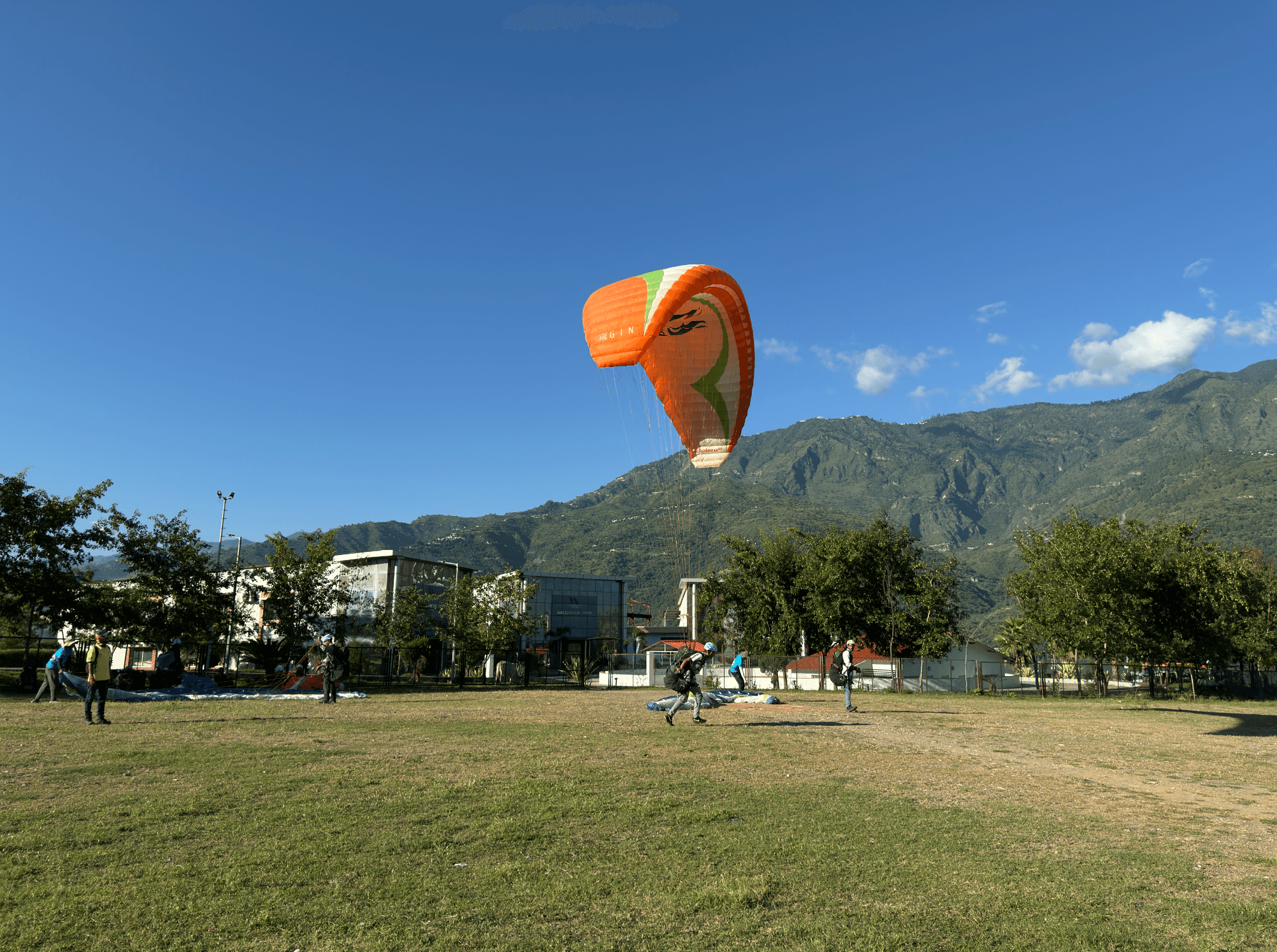
Ground handling teaches the student to inflate, control and stop the wing while remaining on the ground. It develops visual checks, coordinated movement, brake awareness and the ability to abort. Repetition can be physically demanding and may occupy much of an introductory course. It is also one of the strongest foundations for safer launches. Students should not rush past it in pursuit of a social-media first flight.
The instructor chooses a suitable practice area and wind range. Strong, gusty or crosswind conditions are not a shortcut to faster learning. Students must wear protective equipment, maintain spacing and follow commands. Independent practice later should occur only after the instructor has defined suitable limits and site permissions.
Stage three: training hops and supervised solos
Progression may move from controlled low-level exercises to higher supervised flights when the student demonstrates consistent preparation and control. Instructors use radio guidance and coordinate launch and landing. The student learns a planned approach rather than simply steering toward an open field. Weather, individual performance and site availability determine when this stage occurs; classmates may progress at different rates.
A first solo is a milestone, not proof of independent competence. Students need repetition across appropriate conditions, debriefing and growing responsibility for decisions. Honest errors should be discussed without embarrassment. Training records help instructors identify which skills are consistent and which require further work.
Progression after the beginner course
Later levels develop independent site assessment, soaring, thermalling, active piloting, navigation and more advanced safety knowledge. Skills should expand gradually under mentorship. Travelling to a new site introduces unfamiliar terrain, rules and weather, so contact the local club or school and obtain a site briefing. A rating does not remove the obligation to fly within current ability.
Budget for continued instruction, travel, equipment and time rather than treating the first course as the entire investment. Maintain a detailed flight log, review incidents constructively and continue formal learning after every course. Paragliding Mantra offers staged training in Kamshet, but course completion depends on demonstrated skills and flyable conditions. The strongest beginner roadmap is patient: select a credible school, master the ground, progress under supervision and let judgement develop alongside technique.
Thinking about learning to fly?
If this guide has you curious, the natural next step is a supervised tandem or a beginner course. Compare APPI certification courses in India, start with the P1 beginner course, or book an instructional tandem to feel the controls first. Our team on contact can help you pick the right entry point for your goals and dates.
Thinking about learning to fly?
If this guide has you curious, the natural next step is a supervised tandem or a beginner course. Compare APPI certification courses in India, start with the P1 beginner course, or book an instructional tandem to feel the controls first. Our team on contact can help you pick the right entry point for your goals and dates.