The short version
Understand typical age, weight, fitness and health considerations for tandem paragliding in Kamshet, plus what to disclose before booking.
There is no safe universal eligibility number
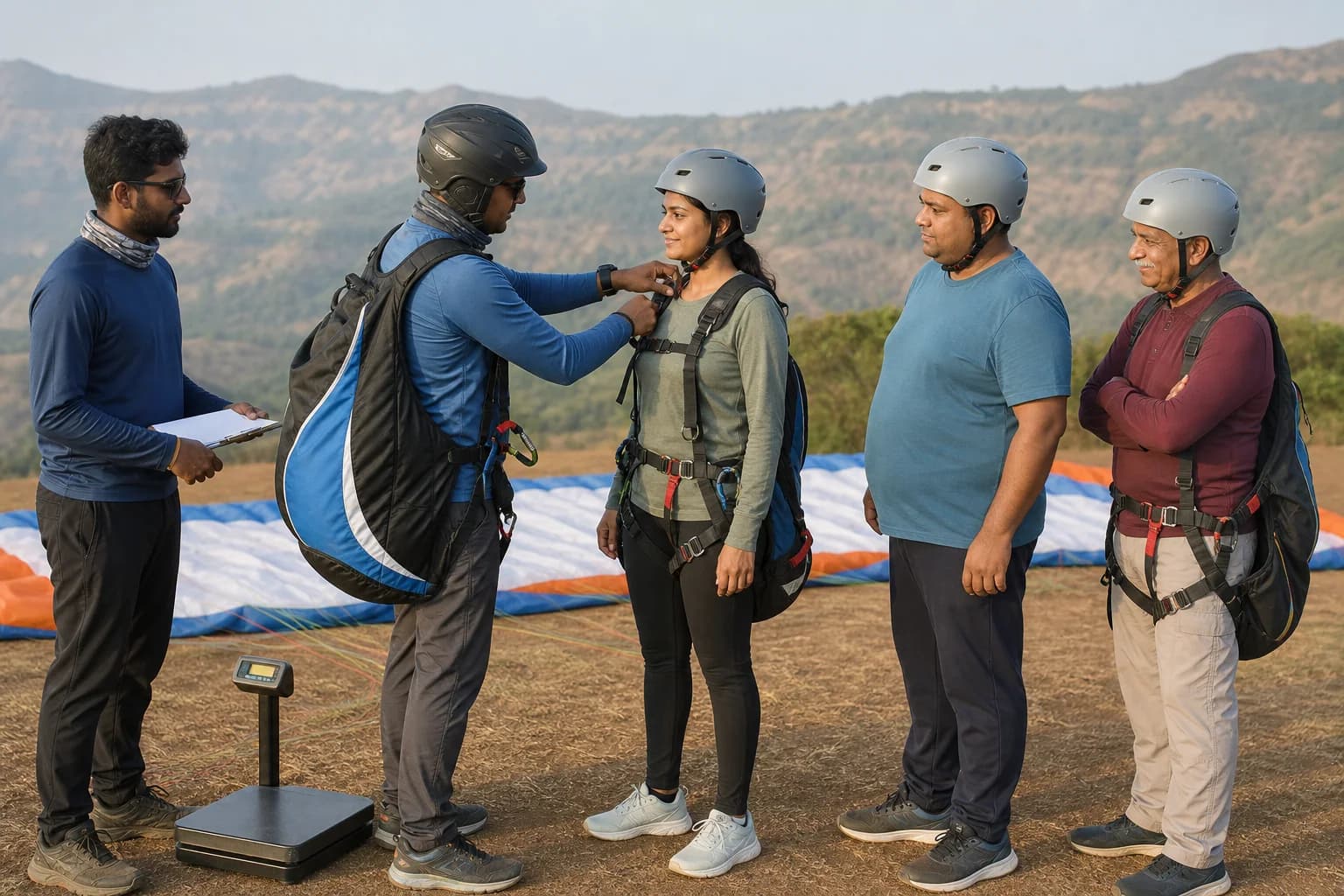
People often ask for one age or weight limit before booking a tandem flight. The honest answer is that eligibility depends on more than a number. The pilot considers the certified range of the wing and harness, passenger and pilot weight, wind, launch surface, landing area, mobility and the operator's procedures. A person accepted on one day may be postponed in different conditions. Confirm your details directly instead of relying on a limit copied from an unrelated destination.
Paragliding Mantra asks guests to share accurate age, approximate weight and relevant health or mobility information before travelling. This is used for planning, not judgement. Hiding information can place the passenger, pilot and ground crew in an avoidable situation at launch. Final approval remains with the tandem pilot after an on-site assessment and current weather check.
How age affects a tandem booking
A younger passenger must be able to understand instructions, wear the available certified harness correctly and cooperate during launch and landing. A parent or legal guardian should provide consent where required and remain involved throughout check-in. Enthusiasm alone is not enough if the child cannot follow a stop command or maintain the required body position. Operators may set their own minimum age or size policy based on equipment and insurance.
Older adults are not automatically excluded. Many active adults can enjoy a tandem flight, but balance, bone health, recent surgery, joint problems and cardiovascular conditions deserve careful discussion. Launch can require several committed steps on uneven ground, while landing technique varies with the conditions. Ask what physical movement is expected and do not treat a tandem as a medically supervised activity.
Why weight limits change with conditions
A tandem paraglider operates within a certified take-off weight range that includes the passenger, pilot, harnesses, reserve and other equipment. Staying inside that range is essential, but it is only the beginning. Wind strength and density affect launch and landing performance. The same passenger weight can present a different operational decision in light wind, stronger wind or at a different site.
Provide a realistic current weight including ordinary clothing. The operator may assign a particular pilot or equipment set, propose a preferred time window or decline the flight. Guests should never attempt rapid dehydration or conceal their weight to meet a booking condition. If an operator states a range, ask whether it is a general booking guide or the final operational limit for that day.
Health conditions to disclose
Tell the team about pregnancy, recent surgery, fractures, severe back or neck problems, uncontrolled blood pressure, significant heart or respiratory illness, seizure conditions, fainting, severe vertigo or any limitation that affects running and balance. This list is not a diagnosis and is not exhaustive. Obtain advice from your own qualified clinician when a condition could make the activity risky. The operator cannot replace medical assessment.
Prescription medication should be taken only as directed by your clinician. Avoid alcohol, recreational drugs and anything that causes drowsiness or impaired coordination. Arrive rested, hydrated and with a light meal unless your clinician advises otherwise. Motion sensitivity can occur, particularly during turns or longer flights, so mention it before launch; the pilot may select a gentler plan when conditions permit.
Mobility and accessible planning
Some guests with disabilities can participate when appropriate equipment, trained support and suitable sites are available. Accessibility is individual and must be arranged in advance. Describe transfers, seating support, communication needs and the assistance you use in daily life. Photographs or a short planning call may help the team understand requirements without making assumptions.
Do not arrive expecting an improvised carry or modified harness. The launch, vehicle access, crew capacity and emergency plan all need review. A postponement may be necessary if wind or ground conditions remove the margin required for an adapted operation. Ask about specialised handi-flying options and whether additional qualified personnel are needed.
Tandem age limits versus learning-to-fly requirements
A tandem passenger and a student pilot are assessed differently. A tandem guest mainly needs to fit the passenger equipment, understand instructions and complete the assisted launch and landing actions. A student must repeatedly carry and control equipment, absorb theory, make decisions, complete ground-handling drills and demonstrate skills over several days. Being accepted for a tandem therefore does not automatically mean being ready for a P1 course.
For a course, the school also considers maturity, concentration, communication, guardian consent for minors, physical capacity and the requirements of the chosen certification system. There is no responsible “anyone can learn” promise. Share age, weight, health, mobility and learning needs before enrolment, then let an instructor recommend a tandem introduction, P1 course, adapted programme or postponement.
A simple pre-booking checklist
Send the operator each passenger's age and approximate weight, disclose relevant conditions, and explain any concern about running or landing. Ask about the meeting point, terrain, clothing, weather policy and identification or consent documents. On arrival, listen to the complete briefing and practise the launch movement. If anything feels unclear, ask before connecting to the wing.
Eligibility is a shared safety conversation rather than a guarantee purchased online. The passenger supplies honest information, the operator plans appropriate resources, and the pilot makes the final decision using real conditions. That approach may occasionally mean waiting or rescheduling, but it gives every suitable guest a better chance of enjoying Kamshet from the air with clear expectations.
Still have safety questions?
Safety is mostly about operator discipline - read how classic tandems are run, browse the FAQs, or ask us directly on contact. When you are ready, joyrides lists current formats.