The short version
Learn what a paraglider wing, harness, reserve parachute, helmet, radio and instruments do, and why inspection and correct matching matter.
A paraglider is a complete system
The colourful canopy is the most visible part of paragliding equipment, but safe operation depends on a matched system: wing, lines, risers, connectors, harness, reserve parachute, helmet and appropriate communication or flight instruments. Tandem equipment is designed and certified for a different loading and purpose from many solo setups. Passengers should use the equipment assigned by the professional rather than choosing by colour or appearance.
Certification does not make equipment automatically suitable for every person or condition. Size, all-up weight, pilot skill, intended use and maintenance history matter. Manufacturers publish manuals and limits for each product. Pilots and schools must understand those documents, complete inspections and retire components when their condition or service life requires it.
The wing, lines and risers
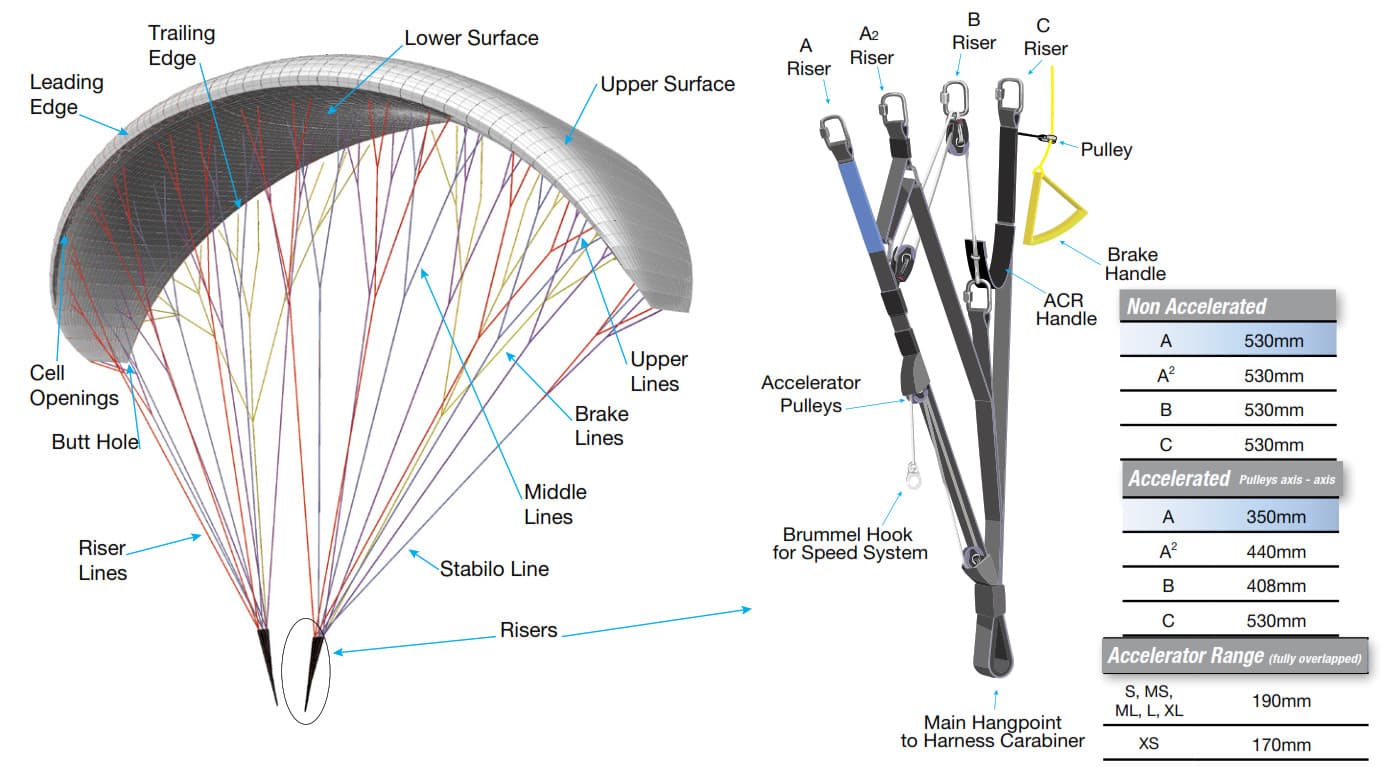
A modern paraglider wing is a fabric aerofoil with cells that inflate through openings along the leading edge. Internal structure gives it shape as air pressure and forward movement create flight. Suspension lines distribute load from the canopy to risers near the pilot. Control handles change the trailing edge and help the pilot steer and manage speed within trained procedures.
Fabric porosity, stitching, line strength and line dimensions can change with use, ultraviolet exposure, moisture, dirt and poor storage. Damage is not always obvious from a distant photograph. Periodic professional checks may measure fabric and line condition in addition to visual inspection. A wing should be packed dry, protected from unnecessary sun and chemicals, and handled according to its manual.
Harnesses and connectors
The harness supports the pilot or passenger and connects to the risers through approved connectors. Tandem systems use separate pilot and passenger harnesses with a spreader arrangement designed for the activity. Adjustment affects fit, posture and control, which is why the crew checks straps before launch. The passenger should never loosen buckles after the inspection.
Harness protection may include foam, airbag or other certified designs, but it does not remove landing risk. Connectors, webbing, buckles, attachment points and reserve installation require routine inspection. Compatibility matters: assembling individually certified pieces without following manufacturer guidance can create an unsuitable system. Repairs and modifications belong with qualified professionals.
The reserve parachute
A reserve is an emergency parachute carried in the harness for situations where normal flight cannot be restored with adequate height. It is not used for routine landing and does not guarantee an injury-free outcome. The pilot needs appropriate training to recognise when deployment is required and to perform the procedure. Passengers must follow the pilot's commands rather than attempting to access it.
Reserve size must match the system's loaded weight and approved speed range. Installation needs a compatible container, handle and connection route. Periodic repacking and inspection follow manufacturer and local professional guidance because packing condition can affect deployment. Simply seeing a handle on a harness does not confirm correct installation or maintenance.
Helmet, radio and instruments
A suitable helmet protects the head during ground movement, launch and landing. It must fit securely without interfering with vision, hearing or harness components. Passengers should fasten it as instructed and report a poor fit. Bicycle, motorcycle and flight helmets are designed around different uses, so an operator should provide equipment appropriate to its operation.
Radios help coordinate instructors, pilots and ground crew but are not a substitute for planning. Students may receive radio guidance during supervised training. Pilots can also use a variometer, altitude information, navigation tools and weather data. Instruments provide useful measurements; they do not override direct observation, airspace rules or conservative judgement.
Pre-flight inspection and care
Before flight, the pilot checks the canopy layout, lines, risers, connectors, harness closures, reserve handle, helmet and surrounding launch area. A consistent sequence reduces the chance of omission. Tandem operations also confirm passenger identity, fit, briefing and communication. If preparation is interrupted, a careful pilot may restart checks rather than relying on memory.
After landing, equipment should be protected from vehicles, spectators, sharp objects and moisture. Sand and dirt can abrade fabric and lines. Wet equipment must be handled and dried appropriately before storage. Maintenance records, service bulletins and inspections help operators track condition instead of judging safety only by the equipment's age or clean appearance.
What the school provides versus what a student brings
A beginner P1 or P2 package commonly provides the training wing, harness, helmet, radio used for supervised exercises, instructor support and local training logistics stated in the written inclusion list. A reserve may be integrated with the relevant flight setup as the syllabus progresses. Exact inclusions vary, so confirm certification fees, site transport, accommodation, meals and weather-extension days separately rather than assuming they are part of the equipment package.
Students normally bring secure shoes, practical layered clothing, water, sun protection, a notebook, identification and any prescribed personal medication. Do not buy a wing, harness, reserve or flight instrument before an instructor assesses your size, progress and likely flying goals. Later, when personal equipment becomes appropriate, request model, size, certification, compatibility, inspection history and total loaded-range guidance in writing.
What a passenger or beginner should ask
A tandem guest can ask whether the equipment is intended for tandem use, how the harness will fit and what the launch commands mean. A student should ask which wing class and size the school uses, how equipment inspections are recorded, and when personal gear becomes appropriate. These are reasonable questions, though a visual check by an untrained guest cannot replace professional maintenance.
Do not buy used flight equipment from an advertisement without instructor input and verifiable inspection history. Paragliding Mantra provides matched equipment for its offered flights and courses. The important principle is reusable everywhere: equipment works safely only as part of trained decisions, correct loading, careful checks and documented care—not as a collection of impressive-looking products.
Ready to fly?
Now that you know what to expect, pick your format on joyrides - the classic tandem for pure sightseeing or instructional for a hands-on taste. Confirm your slot through contact.