The short version
Use this practical checklist to compare Kamshet paragliding operators by pilot credentials, equipment, weather policy, briefing and transparent pricing.
Look beyond the cheapest headline price
A tandem booking places the passenger in the care of a pilot, equipment system and ground operation. Compare more than a price card or dramatic social-media clip. Ask who will fly, what package is included, how weather decisions are made and what happens if the site does not open. A clear operator welcomes reasonable questions and does not replace answers with a promise that nothing can go wrong.
Prices can differ because duration targets, pilot allocation, transport, media, site access and package type differ. Confirm the total payable amount and possible extras in writing. An unusually low offer may simply exclude services, while a high price alone proves nothing about quality. Transparency is more useful than either extreme.
Verify pilot experience and credentials
Ask for the pilot or organisation's relevant tandem qualifications and current experience. Understand which issuing or training system is referenced instead of treating every badge as identical. A solo rating, course-completion photo or long personal flying history does not automatically demonstrate a professional tandem qualification. The operator should be able to explain its pilots' roles without becoming defensive.
Recent site experience matters because Kamshet's launch choices, local airflow, landing fields and community arrangements change. Good professionals continue learning, log flights and respect site procedures. Avoid judging competence only by follower counts or stunt footage; commercial passenger flying rewards conservative decisions and consistent preparation more than spectacle.
Ask about equipment and checks
The wing and harnesses should be intended for tandem use, correctly matched to loaded weight and maintained according to manufacturer guidance. A reserve parachute and suitable helmets are parts of the system, not decorations. Ask how equipment condition and periodic inspections are tracked. Passengers cannot perform a technical inspection, but an operator should have an organised answer.
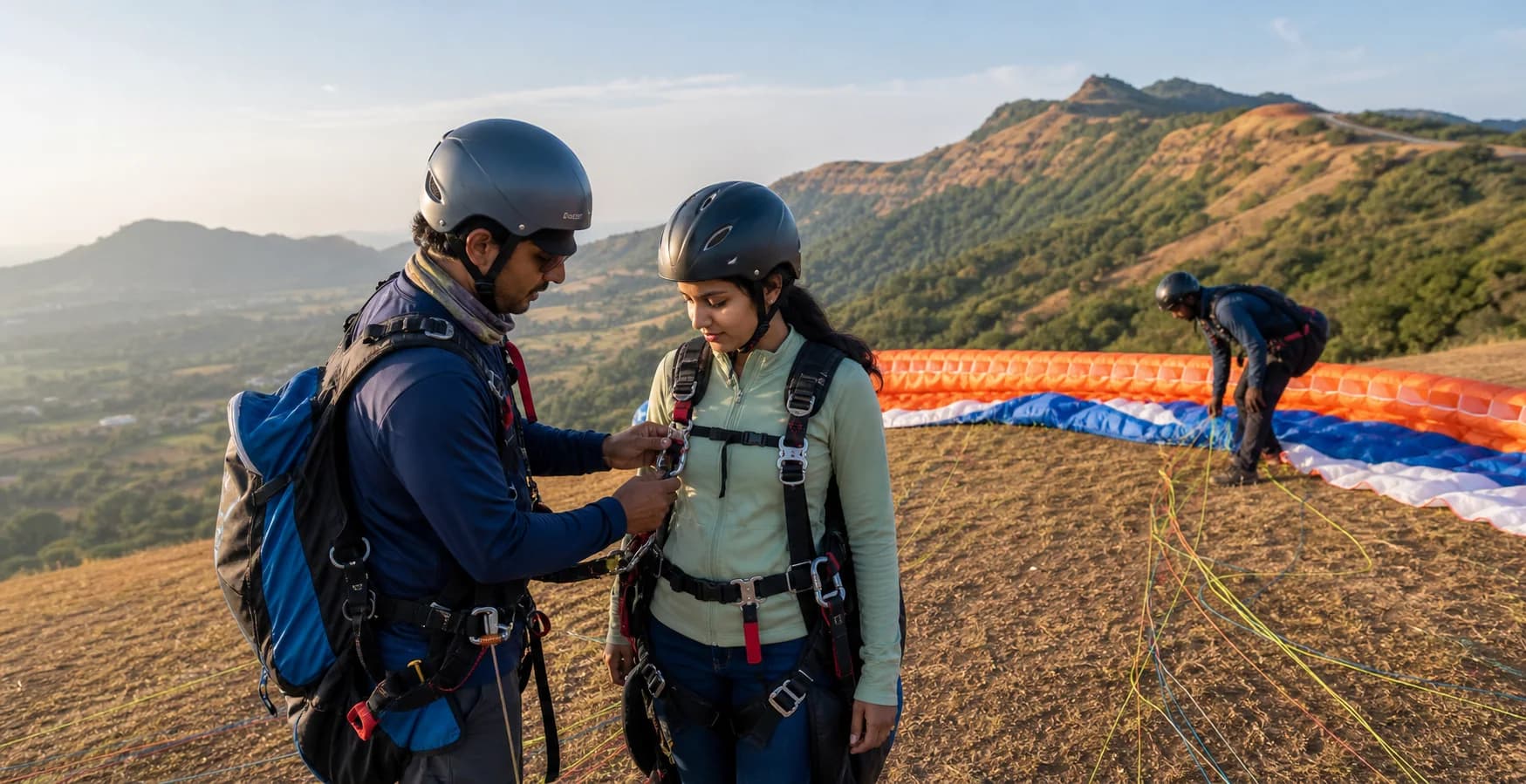
Observe the pre-flight routine. The crew should fit the harness, secure leg and chest straps, check connections, arrange lines and brief the launch clearly. Preparation may be restarted after an interruption. Do not pressure the team to skip checks for a video, and never loosen a buckle after fitting without telling the pilot.
Weather policy reveals safety culture
No ethical operator can guarantee a flight before evaluating the day's wind, gusts, cloud, visibility, launch and landing. Ask whether the booking can be delayed, moved, rescheduled or refunded under defined conditions. Vague statements such as flying happens in every weather should be treated cautiously. A cancellation can be evidence of responsible judgement rather than poor service.
The final call belongs to the responsible pilot. Another wing in the air does not prove your tandem should launch because equipment, loading, pilot skill and timing may differ. A trustworthy team explains the hold and provides the next review or policy option without inviting passengers to vote on an operational limit.
Briefing, communication and passenger screening
Before booking, the operator should request relevant age, weight, health and mobility details. At launch, the passenger needs understandable commands for preparation, running, seating and landing. Language or accessibility requirements should be discussed in advance. A rushed instruction shouted only when the wing is rising is not a proper briefing.
The passenger also has responsibilities: provide honest information, arrive sober, wear secure footwear and follow commands. Ask questions before connection if something is unclear. Good service does not mean agreeing to every request; pilots may decline unsuitable clothing, an unsafe camera arrangement or acrobatic manoeuvres that do not fit the package and conditions.
Reviews, contact details and local presence
Read recent detailed reviews across more than one platform, looking for consistent comments about communication, waiting, safety explanations and handling cancellations. Perfect ratings with repetitive wording deserve closer examination. Check whether the business publishes a working phone number, meeting process, policies and an identifiable local presence. Save the confirmed contact before travelling.
A website name can be copied by resellers, so establish who receives payment and who is responsible for the flight. Request a receipt or written confirmation containing date, passenger count, package and policy. Do not send money merely because a chat account uses familiar photographs. Use the organisation's verified contact route whenever possible.
Choosing a training school is different from choosing a tandem operator
For a course, ask who teaches each stage, the maximum student-to-instructor ratio during practical work, which syllabus and rating system is used, how flights and tasks are logged, and what happens when weather prevents completion. A school should explain post-course supervision and progression—not simply promise a certificate after a fixed number of paid days.
Compare value through instructor contact, supervised practice, equipment, transport, assessment and weather-day support rather than the cheapest headline fee. Ask to speak with recent students, but verify that testimonials are genuine and relevant to the same course level. The beginner Kamshet course and course price guide show the questions and inclusions to compare.
A practical decision checklist
Choose the operator that gives verifiable answers about pilots, matched equipment, passenger screening, weather decisions, inclusions and cancellation terms. Confirm the current meeting point rather than following an old map pin. Keep half a day flexible, because even the most organised team cannot control the atmosphere or road access.
Paragliding Mantra publishes its team, offered flight types, Kamshet contact information and policies so guests can make an informed comparison. You should apply the same checklist to us as to anyone else. The best booking is not the loudest claim; it is a transparent operation whose people, preparation and decisions remain credible when conditions are inconvenient.
Still have safety questions?
Safety is mostly about operator discipline - read how classic tandems are run, browse the FAQs, or ask us directly on contact. When you are ready, joyrides lists current formats.